Call us at : +91-9650662227 or mail us at sales@ganpatifibretech.com for enquiry
Impact of the Iran–US Conflict on Epoxy Resin Supply and Pricing
The Iran–US conflict has highlighted the vulnerability of global petrochemical supply chains to geopolitical risks. For companies like Ganpati Fibretech, this environment necessitates proactive sourcing strategies, inventory planning, and cost optimization. As epoxy resin remains a critical raw material, staying informed and adaptable will be key to navigating this period of uncertainty and maintaining operational resilience.
Ankit Kaushik
4/7/20262 min read
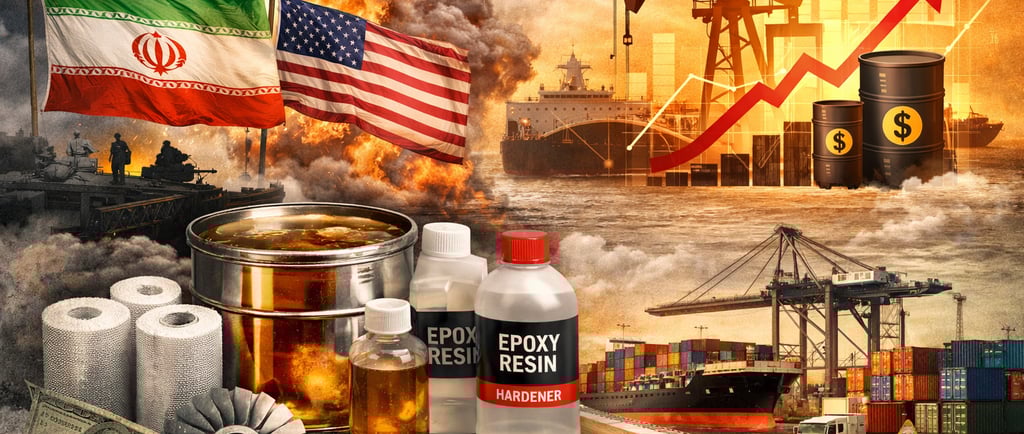
The ongoing geopolitical tensions between Iran and the United States have created significant disruptions across global supply chains, particularly in the petrochemical sector. As epoxy resin is fundamentally derived from petrochemical feedstocks, the conflict has had a direct and measurable impact on its availability, production, and pricing. For manufacturers like Ganpati Fibretech, understanding these dynamics is essential for strategic planning and cost management.
Disruption in Petrochemical Supply Chains
One of the most critical factors influencing epoxy resin supply is the disruption of crude oil and petrochemical flows through the Strait of Hormuz—a key global shipping route. The conflict has led to restricted movement of raw materials such as naphtha, which is a primary feedstock for producing resins and plastics. Reports indicate that petrochemical supply chains have been severely strained, with shortages emerging across Asia and Europe due to reduced exports from the Middle East. (Reuters)
Additionally, damage to production facilities and logistical bottlenecks have further constrained supply. The Middle East, which plays a major role in global petrochemical output, has seen reduced production capacity due to ongoing hostilities. (Chemical & Engineering News) This has created a ripple effect across industries dependent on these materials, including coatings, electrical insulation, and composites—key applications of epoxy resins.
Rising Feedstock Costs Driving Price Increases
Epoxy resin production is closely tied to crude oil derivatives such as bisphenol A (BPA) and epichlorohydrin. As oil prices surge due to supply uncertainty, the cost of these raw materials increases correspondingly. Recent data shows that oil prices have risen sharply due to the conflict, with a significant portion of global oil supply affected. (Reuters)
This increase in feedstock cost directly translates into higher resin prices. Industry insights highlight that resin markets are experiencing strong inflationary pressure, with some plastic and polymer prices increasing by up to 50% in certain regions. (Reuters) Furthermore, the volatility in oil markets has introduced pricing uncertainty, making it difficult for manufacturers to forecast costs accurately.
Production Slowdowns and Capacity Constraints
Beyond raw material costs, production itself has been impacted. Many manufacturers across Asia and Europe are facing reduced operating rates due to both energy shortages and limited feedstock availability. In some cases, factories have been forced to cut output or temporarily shut down. (Reuters)
This tightening of supply has created a seller’s market for resin producers, where demand outpaces available inventory. As a result, buyers—including epoxy resin consumers—are experiencing delayed deliveries and increased procurement challenges. (Plastics Today)
Logistics and Transportation Challenges
The war has also significantly increased transportation and logistics costs. Shipping routes have been disrupted, insurance premiums for cargo have risen, and alternative routes are adding both time and cost to deliveries. These factors further inflate the landed cost of epoxy resins, especially for import-dependent markets like India. (Global Connect Corporation)
Implications for the Epoxy Resin Industry
For epoxy resin manufacturers and users, the combined impact of supply shortages, rising feedstock costs, and logistical challenges is leading to sustained price increases and reduced margin predictability. Industries such as electrical components, construction, automotive, and composites are all feeling the pressure.
In the short term, prices are expected to remain volatile and elevated. Even if the conflict stabilizes, rebuilding supply chains and restoring production capacity may take several months, prolonging the impact on resin markets. (Chemical & Engineering News)
Conclusion
The Iran–US conflict has highlighted the vulnerability of global petrochemical supply chains to geopolitical risks. For companies like Ganpati Fibretech, this environment necessitates proactive sourcing strategies, inventory planning, and cost optimization. As epoxy resin remains a critical raw material, staying informed and adaptable will be key to navigating this period of uncertainty and maintaining operational resilience.
Contact
Phone
sales@ganpatifibretech.com
+91-9650662227
© 2026. All rights reserved.